Joint Glide Review: Scam or Legit? Ingredients, Price & Side Effects (2026)
Affiliate Disclosure: This post contains an affiliate link. If you purchase through it, we may earn a commission at no extra cost to you. This does not influence our rating. See our Affiliate Disclosure page.
Medical disclaimer: This article is for informational purposes only and is not medical advice. Individual results vary. Consult a healthcare professional before starting any supplement, especially if you take other medications, or if you have a diagnosed joint condition.
Joint mobility note: Joint Glide is a dietary supplement marketed for general joint comfort and mobility support. It is not a treatment for arthritis, a diagnosed joint disease, or any other medical condition, and it has not been evaluated by the FDA. Persistent joint pain, swelling, or stiffness can have many underlying causes, so see a doctor or physical therapist for a proper diagnosis, especially if pain is severe, sudden, or accompanied by swelling, redness, or fever.
Quick Verdict
| Product | Joint Glide (capsule supplement) |
| Category | Capsule supplement marketed for joint comfort, flexibility, and cartilage support |
| Our Rating | 5.5/10. A ten-ingredient formula built around several genuinely studied joint-comfort compounds (devil’s claw, white willow bark, MSM, glucosamine), undercut by a dramatized “rust enzyme” marketing narrative and a long advertorial sales page that oversells the mechanism far beyond what the ingredient research actually supports. |
| Price | $69 for a 30-day, 1-bottle supply, dropping to $59/bottle (3 bottles) or $49/bottle (6 bottles), per the vendor’s sales page. Confirm the current terms at checkout before buying. |
| Best For | Adults looking for a multi-ingredient joint-comfort capsule who can look past the dramatized marketing story and focus on the actual ingredient panel, which includes several compounds with real, if modest, human evidence for joint comfort and mobility. |
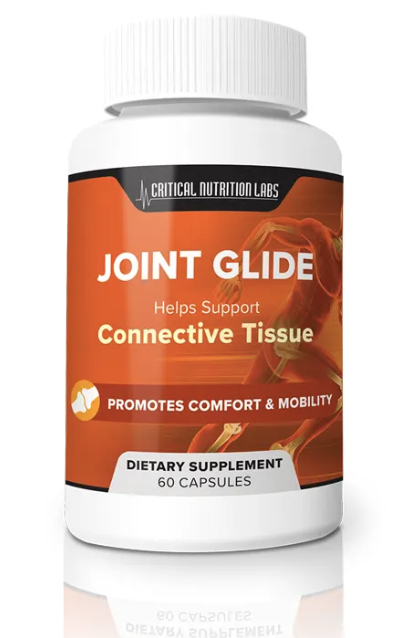
Joint Glide is a capsule-based supplement sold through a long-form advertorial sales page and positioned around blocking a so-called “rust enzyme” (matrix metalloproteinase, or MMP) that the marketing claims is the real driver of joint deterioration. See also our full Top Joint Pain & Health Supplements 2026, Ranked & Compared for how it compares against the other joint-health products we’ve reviewed.
What Is It?
Joint Glide is a ten-ingredient capsule supplement sold exclusively through its official site. The sales page is a long narrative-style advertorial built around a fictional “patient” story and a licensed athletic trainer as narrator, and centers its pitch on the idea that an enzyme called matrix metalloproteinase (MMP), triggered by everyday heavy-metal exposure, is the real cause of joint pain, more so than normal wear and tear or inflammation. The formula is built around pine bark extract as the headline ingredient, alongside nine supporting compounds.
How Does It Work?
MMP enzymes are real and do play a documented role in cartilage turnover, but the sales page’s framing, that heavy metals are the primary driver of MMP activity in ordinary joint pain and that Joint Glide “blocks” this process, is a significant dramatization of a more nuanced and incomplete area of research. Several of the formula’s ingredients, particularly devil’s claw and white willow bark, do have real evidence for reducing joint pain and inflammation through more conventional, well-established anti-inflammatory pathways, separate from the “rust enzyme” narrative used to sell the product.
Ingredients Breakdown
The sales page does not publish individual milligram doses for the ten ingredients in a clear Supplement Facts table within the text we reviewed, so exact dosing cannot be independently confirmed. Here is what’s included and what the evidence actually supports, separate from the vendor’s “rust enzyme” framing:
| Ingredient | Vendor’s Stated Role | What the Evidence Says |
|---|---|---|
| Pine Bark Extract (Pinus massoniana) | Neutralizes the “rust enzyme” and rebuilds collagen and cartilage | Pine bark extracts (most commonly studied as Pycnogenol) have real clinical trial evidence for reducing joint pain and stiffness in osteoarthritis, likely through antioxidant and anti-inflammatory mechanisms. The specific “rust enzyme” framing and cartilage-rebuilding claim goes beyond what the studies directly show. |
| Devil’s Claw Extract | Lowers joint pain and inflammation, regrows cartilage and collagen | One of the better-evidenced botanicals in this category; multiple human trials support devil’s claw for reducing osteoarthritis and general joint pain, with effects sometimes comparable to NSAIDs in head-to-head studies. Claims about actively “regrowing” cartilage go beyond the pain-relief evidence base. |
| White Willow Bark Extract | Reduces pain and inflammation, protects collagen | Contains salicin, a natural precursor related to aspirin’s active compound, with reasonable evidence for reducing pain and inflammation in musculoskeletal conditions. A legitimately studied, traditional anti-inflammatory. |
| MSM (Methylsulfonylmethane) | Provides raw materials for collagen production | Several placebo-controlled trials support MSM for modestly reducing osteoarthritis pain and stiffness over several weeks of use. One of the more consistently evidenced joint-comfort ingredients on the market. |
| Glucosamine | Building block for cartilage, keeps joints flexible | Decades of research on glucosamine for osteoarthritis show mixed results overall; some trials show modest benefit for pain and function, others show no significant difference from placebo. A well-studied but inconsistent ingredient. |
| Zinc, Copper, Magnesium, Vitamin B6 | Support collagen production and chondrocyte function | All four are legitimate essential nutrients with documented roles in connective tissue and enzyme function. Supplementing beyond a normal, sufficient level has not been shown to meaningfully improve joint pain on its own in people who are not deficient. |
| Black Pepper Extract (Piperine) | Reduces pain and inflammation | Piperine has some evidence for anti-inflammatory activity and is also commonly added to improve the absorption of other ingredients. Direct joint-pain trial evidence for piperine alone is limited. |
Taken as a whole, Joint Glide’s actual ingredient panel is more credible than its marketing narrative: several components (devil’s claw, white willow bark, MSM) have genuine, if modest, human evidence for joint comfort, even though the “rust enzyme” heavy-metal storyline used to sell the product is a significant oversimplification of the underlying science.
Pros and Cons
Pros
- Includes several ingredients (devil’s claw, white willow bark, MSM) with genuine, published human evidence for joint pain and stiffness
- Reasonably comprehensive ten-ingredient panel that also covers connective-tissue-supporting minerals and vitamins, not just a single headline compound
- Manufactured, per the vendor, in a GMP-certified US facility with vegetarian, non-GMO capsules
- Backed by a 60-day money-back guarantee
Cons
- Heavily dramatized “rust enzyme” marketing narrative: the long advertorial sales page frames ordinary joint pain as primarily caused by toxic heavy metals overactivating MMP enzymes, a storyline that significantly oversimplifies a genuinely more complex and incomplete area of research
- No disclosed Supplement Facts panel: individual ingredient doses aren’t published in the text we could review, so it isn’t possible to independently confirm any ingredient is present at a clinically meaningful amount
- No clinical trial of the finished Joint Glide formula itself is cited, only trials or reviews on individual ingredients in isolation
- Sold only through the official site, so there is no independent retailer pricing or review history to cross-check
Pricing & Where to Buy
Joint Glide is sold only through its official site, with ClickBank as the payment processor and retailer of record. Per the sales page at the time of this review: a single bottle (30-day supply, 60 capsules) is $69 plus a small shipping fee, three bottles (90-day supply) work out to $59 per bottle with free shipping, and six bottles (180-day supply) work out to $49 per bottle with free shipping. Promotional pricing on these advertorial-style pages changes often, so confirm the current terms and total at checkout before buying.
The vendor advertises a 60-day, 100% money-back guarantee, and states that a refund applies even if you’ve used the entire bottle. As with any ClickBank purchase, refund requests go through the vendor’s own support process, so keep your order confirmation and follow their stated refund steps.
Is It Legit or a Scam?
Joint Glide is sold through ClickBank, an established affiliate marketplace with buyer purchase protection, and the sales page carries standard supplement disclaimers. That is a legitimate transaction structure. The bigger issue is the marketing style: this is a long-form advertorial built around a dramatized personal story and a simplified “rust enzyme” villain narrative, a common persuasion pattern in this industry that tends to overstate the certainty and completeness of the underlying science, even when, as here, several of the actual ingredients do have genuine supporting research.
Be skeptical of any joint supplement, including this one, that frames a single enzyme or toxin as “the real cause” of joint pain while dismissing conventional explanations like wear and tear, injury history, or inflammation, since joint pain in real patients typically has multiple contributing causes that a doctor or physical therapist is better positioned to evaluate than a sales page.
FAQ
Will Joint Glide cure my arthritis or joint disease?
No. No dietary supplement, including Joint Glide, can cure arthritis or reverse a diagnosed joint disease. If you have persistent joint pain, swelling, or stiffness, see a doctor or physical therapist for a proper diagnosis and treatment plan.
What’s actually in Joint Glide?
Pine bark extract (Pinus massoniana), devil’s claw extract, white willow bark extract, MSM, glucosamine, zinc, copper, magnesium, vitamin B6, and black pepper extract, per the vendor’s ingredient list. Individual milligram doses are not published in a clear Supplement Facts table on the pages we reviewed.
Is Joint Glide safe?
The individual ingredients are generally recognized as well-tolerated at typical supplement doses, but white willow bark contains a natural aspirin-like compound, so talk to your doctor before starting it if you’re on blood thinners, have an aspirin allergy or sensitivity, or take other medications.
How long until I notice anything?
The vendor claims some users notice a difference within 3 to 7 days, with fuller benefits after 90 days of consistent use. As with most joint supplements, expect any real effect, if there is one, to build gradually over several weeks, not overnight.
Is there a refund if it doesn’t work for me?
The vendor advertises a 60-day, 100% money-back guarantee, even on an opened or fully used bottle, run through ClickBank. Confirm the current refund terms and process on the official order page before you buy.
Final Verdict
Joint Glide’s actual ingredient panel is more credible than its sales page lets on: devil’s claw, white willow bark, and MSM all have genuine, if modest, human evidence for joint pain and stiffness, and the mineral and vitamin additions are reasonable connective-tissue support. The dramatized “rust enzyme” and heavy-metal narrative used to sell it is a significant overreach that isn’t necessary to make a fair case for trying this formula. If you can look past the storytelling and focus on the ingredient list, this is a reasonable, if unproven, option to try for general joint comfort, backed by a generous 60-day guarantee. If you have persistent joint pain, swelling, or a suspected injury, see a doctor or physical therapist first; no supplement is a substitute for proper diagnosis and care.
Affiliate Disclosure: This post contains an affiliate link, and we may earn a commission if you purchase through it, at no extra cost to you.
Before you buy: this product’s official sales page frames its “rust enzyme” mechanism far more dramatically and confidently than the independent research on its ingredients actually supports. Read the breakdown above, weigh it against the vendor’s own marketing, and if you have persistent or worsening joint pain, see a doctor before trying any supplement.
See how it compares: Joint Glide vs Joint Genesis.