Magic Burn Review: Scam or Legit? Ingredients, Price, and a Serious Ad Funnel Red Flag (2026)
Affiliate Disclosure: This post contains an affiliate link. If you purchase through it, we may earn a commission at no extra cost to you. This does not influence our rating. See our Affiliate Disclosure page.
Medical disclaimer: This article is for informational purposes only and is not medical advice. Individual results vary. Consult a healthcare professional before starting any supplement, especially if you take other medications or have a liver, kidney, or heart condition. Statements have not been evaluated by the FDA. This product is not intended to diagnose, treat, cure, or prevent any disease.

Quick Verdict
| Product | Magic Burn |
| Category | Capsule marketed for weight loss, framed around a ‘7-second morning ritual’ and a ‘fat-burning switch’ story |
| Our Rating | 4.0/10. A comparatively mild on-page pitch built from six common ingredients, dragged down hard by independently documented fake-endorsement advertising used to sell it |
| Price | $69 for a single 30-day bottle; $59 per bottle on the 3-bottle package; $39 per bottle on the 6-bottle package (prices shown on the vendor’s site at the time of writing) |
| Money-Back Guarantee | 60 days, no questions asked, per the vendor’s stated policy |
| Best For | Only people who found this page directly and never saw Magic Burn’s paid ad campaigns; see the red flag section below before you consider buying |
| Not Ideal For | Anyone who was persuaded to consider this product by an ad implying a Harvard, Mayo Clinic, or Johns Hopkins connection, or a ‘doctor’ testimonial, since those endorsements are not real |
What Is Magic Burn?
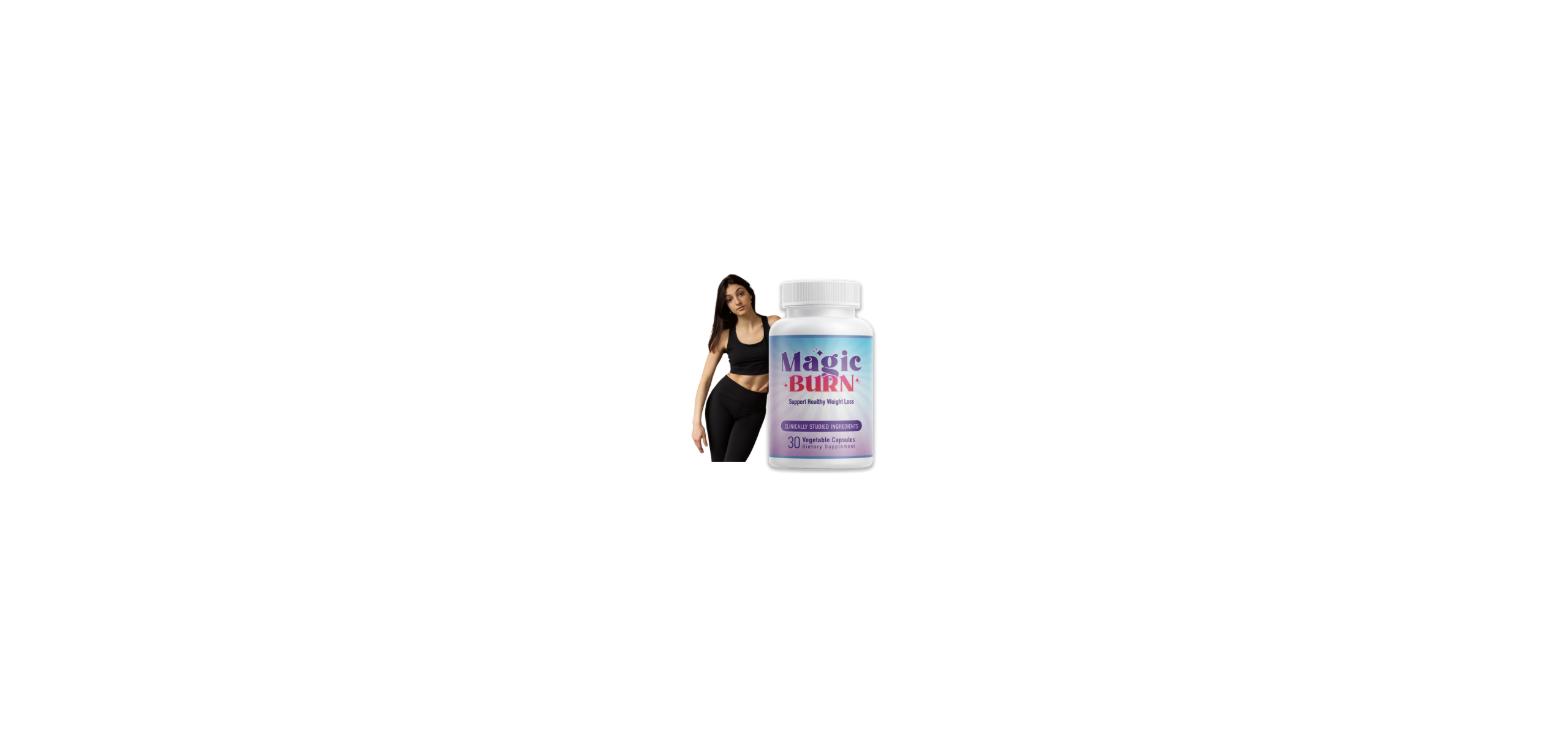
Magic Burn is a ClickBank-sold weight-loss capsule from takemagicburn.com. Compared to many products in this category, the on-page sales copy itself is fairly restrained: it talks about a ‘fat-burning switch,’ a ‘7-second morning ritual’ (which just means swallowing the capsule with cold water), and general language about metabolic efficiency and a ‘fat-burning window.’ It cites six named ingredients and includes a standard FDA disclaimer plus an explicit note that the product is not endorsed by, sponsored by, or affiliated with any of the research organizations it cites for background science.
That last detail matters, because as you will see below, the restraint on the sales page itself does not extend to how this product has reportedly been advertised elsewhere.
Ingredients Breakdown
Magic Burn lists six named ingredients per capsule. No specific per-ingredient milligram doses are disclosed on the public sales page.
| Ingredient | Claimed Benefit (per manufacturer) | Evidence Grade |
|---|---|---|
| Milk thistle | Supports liver detoxification and fat processing | C: decent evidence for liver-marker support, weak direct weight-loss evidence |
| Resveratrol | Promotes fat metabolism, may reduce fat cell formation, supports insulin sensitivity | C: promising early research, weak direct human weight-loss evidence |
| Berberine root | Regulates blood sugar and insulin, reduces fat storage | B: one of the better-studied ingredients here for blood sugar, usually at gram-level doses not disclosed in this product |
| Chromium | Improves carbohydrate processing, reduces cravings | C: reasonable evidence for blood sugar support, weak evidence specifically for weight loss |
| Cayenne fruit | Boosts thermogenesis and calorie burn | C: modest evidence for a small thermogenic effect at studied doses |
| Green tea (EGCG) | Antioxidant, increases metabolism and fat oxidation | C to B: one of the more consistently studied ingredients in this category, though effects depend on dose, which is not disclosed here |
None of these six ingredients are unusual or exotic, and several have genuine, if modest, research behind them individually. As with most ClickBank weight-loss capsules, there is no published clinical trial on Magic Burn as a finished, six-ingredient formula, and no disclosed per-ingredient doses to compare against the studies these ingredients are known from.
Pros and Cons
Pros
- The on-page sales copy is more restrained than many competitors: it explicitly disclaims any endorsement by the research organizations it cites
- All six named ingredients are common, well-known supplement ingredients rather than obscure proprietary blends
- Pricing and a 60-day money-back guarantee are stated clearly and consistently on the sales page
- Stated as a one-time payment with no auto-ship or subscription, according to the vendor’s own FAQ
Cons
- Independently documented advertising for this product uses fake Harvard, Mayo Clinic, and Johns Hopkins branding, and deepfake-style ‘doctor’ testimonials; see the section below
- No per-ingredient doses disclosed on the sales page
- No clinical trial on the finished six-ingredient formula, only on some individual ingredients in other contexts
- Blanket claim that the product ‘has changed the lives of thousands of men and women aged 18 to 95’ with no caveats for older adults or people on medication
- Customer testimonials on the page (specific pound-loss figures like 15, 20, and 40 pounds) are not independently verifiable
Pricing and Refund Policy
| Package | Price | Shipping |
|---|---|---|
| 1 bottle (30-day supply) | $69 | $9.99 |
| 3 bottles (90-day supply) | $59 per bottle ($177 total) | Free |
| 6 bottles (180-day supply) | $39 per bottle ($234 total) | Free |
The vendor states a 60-day, 100 percent money-back guarantee: return all bottles, even if empty, for a full refund, no questions asked, per the site’s own FAQ. The vendor also states this is a one-time payment with no subscription or auto-ship. As with any ClickBank purchase, confirm current pricing and terms at checkout, since promotional pricing can change.
Serious Red Flag: Fake Institutional Logos in the Ad Funnel
This is the most important section of this review. Independent consumer-protection and scam-pattern reporting on Magic Burn’s advertising (see Sources) documents a pattern that is materially more serious than what appears on the sales page itself:
- Ads reportedly display the names and logos of Harvard, Johns Hopkins, Mayo Clinic, and ABC News, implying an institutional connection or endorsement that does not exist. As the independent reporting we reviewed puts it, a page can display a logo, but that does not mean the organization approved the product.
- The ad funnel reportedly uses deepfake-style footage of TV doctors or medical personalities, AI-generated before-and-after images, and scripted testimonials presented as if they were personal and spontaneous.
- Ads reportedly use news-style advertorial layouts designed to look like CNN or Fox News coverage rather than paid advertising.
- The funnel reportedly layers in artificial urgency tactics: countdown timers and fake low-stock warnings.
We want to be precise about what we can and cannot verify ourselves: we reviewed the vendor’s own sales page directly, and it is more restrained than the ad-funnel pattern described above, going as far as to state in its own fine print that Magic Burn ‘is not endorsed by, sponsored by, or affiliated with any of these organizations’ regarding the research it cites. We were not able to independently pull the specific ad creative described in third-party reporting ourselves, since paid ad campaigns are not permanently archived the way a sales page is. We are relaying this because it comes from independent, detailed scam-pattern reporting rather than a vague rumor, and because it is exactly the kind of thing a shopper deserves to know before buying: if you saw Magic Burn advertised anywhere with a Harvard, Mayo Clinic, or Johns Hopkins name or logo attached, or a ‘doctor’ giving a testimonial, treat that specific ad as misleading, regardless of how the product itself is described on its own site.
This pattern, institutional-sounding branding used without a real endorsement, is similar in kind to what we found and flagged in our Nitric Boost Ultra review, where NEJM, PubMed, NIH, and Johns Hopkins logos appeared near testimonials on the sales page itself. The difference here is that the institutional-logo misuse for Magic Burn is reported in the ad funnel rather than on the landing page we reviewed directly, which is a real distinction, but not one that should make you feel better about it: it means the deception is happening in the traffic-generation ads that bring people to the site, which is arguably harder for a shopper to fact-check in the moment than a claim sitting on the page in front of them.
Is It Legit or a Scam?
Magic Burn is a real, purchasable product sold through ClickBank with a stated 60-day refund policy, so it is not a scam in the sense of taking money and delivering nothing. However, given the documented use of fake institutional endorsements and deepfake-style testimonials to advertise it, we cannot call this a fully trustworthy marketing operation. Our advice: if you are interested in the ingredient list on its own merits, buy directly from the official site rather than whatever ad you may have originally seen, keep your purchase records, and do not put any weight on implied Harvard, Mayo Clinic, or Johns Hopkins involvement, because there is none.
FAQ
Is Magic Burn actually connected to Harvard, Mayo Clinic, or Johns Hopkins?
No. The vendor’s own sales page states in its fine print that the product is not endorsed by, sponsored by, or affiliated with the research organizations it cites, and independent reporting describes ads using those institutions’ names and logos without authorization. Treat any implied connection as false.
Are the customer testimonials on the sales page real?
We cannot verify them independently, and given the documented pattern of deepfake-style content in this product’s advertising, we would treat specific pound-loss testimonials with real skepticism.
Does Magic Burn require a specific diet or exercise plan?
The vendor markets it as working without diet or exercise changes. As with any weight-loss supplement, sustained results for most people still depend on overall calorie balance over time.
What is the refund policy?
60 days, 100 percent money-back, return all bottles even if empty, per the vendor’s stated FAQ. Confirm current terms at checkout.
Final Verdict
Taken purely on its own sales page, Magic Burn is a middling ClickBank weight-loss capsule: six common ingredients, some genuine but modest research behind a few of them, undisclosed doses, and reasonable pricing with a clear 60-day guarantee. What pulls our score down to 4.0 out of 10, in the same range as our Nitric Boost Ultra review, is independently documented evidence that this product has been advertised using fake Harvard, Mayo Clinic, and Johns Hopkins branding and deepfake-style testimonials. Consumers deserve to know that the ads that may have brought them to this page are not trustworthy, even where the landing page itself is comparatively mild. If you still want to try it after reading this, do so with your eyes open about the ad funnel, and buy only through the official site directly.
Sources
- Malwaretips.com, ‘Magic Burn Supplement EXPOSED: Scam Ads and Red Flags’
- Vendor sales page, takemagicburn.com (accessed September 2026), including its own institutional-endorsement disclaimer
- National Institutes of Health, National Center for Complementary and Integrative Health, ingredient monographs for berberine and green tea catechins
- Rovuno Reviews, Nitric Boost Ultra Review (for comparison of a similar implied-institutional-endorsement pattern)