Nerve Armor Review: Scam or Legit? Ingredients, Price & Side Effects (2026)
Affiliate Disclosure: This post contains an affiliate link. If you purchase through it, we may earn a commission at no extra cost to you. This does not influence our rating. See our Affiliate Disclosure page.
Medical disclaimer: This article is for informational purposes only and is not medical advice. Individual results vary. Consult a healthcare professional before starting any supplement, especially if you take other medications or have a liver, kidney, heart, or neurological condition. Statements have not been evaluated by the FDA. This product is not intended to diagnose, treat, cure, or prevent any disease.
Nerve health note: Nerve Armor is not a treatment for diabetic neuropathy, chemotherapy-induced neuropathy, multiple sclerosis, or any other diagnosed nerve or spinal condition, and it is not a substitute for a prescribed medication such as gabapentin, pregabalin, or duloxetine. Persistent or worsening numbness, tingling, burning, weakness, or pain in your hands, legs, or feet should be evaluated by a doctor or neurologist, since these symptoms can have serious underlying causes that need proper diagnosis. Never stop or change a prescribed medication because of a supplement or an article like this one.
Quick Verdict
| Product | Nerve Armor (capsule supplement) |
| Category | Supplement marketed for nerve health support: soothing burning, tingling, and numbness sensations in the hands, legs, and feet |
| Our Rating | 4.0/10. The five named ingredients (PEA, gotu kola, corydalis, benfotiamine, alpha lipoic acid) have genuine nerve-health research behind them individually, but the sales page leans heavily on a dramatized, non-medical “termite cell” narrative and undisclosed dosing for four of the five ingredients |
| Price | As listed at time of review: $59 + $7.99 shipping for 1 bottle, $49/bottle for 3 bottles ($147, free shipping), $39/bottle for 6 bottles ($234, free shipping). Confirm current pricing on the official checkout page before entering payment details |
| Money-Back Guarantee | 60 days, per the vendor’s guarantee page. Confirm the current terms at checkout before buying |
| Best For | Adults looking for a natural, capsule-based nerve-support supplement to try alongside (not instead of) medical care for nerve discomfort |
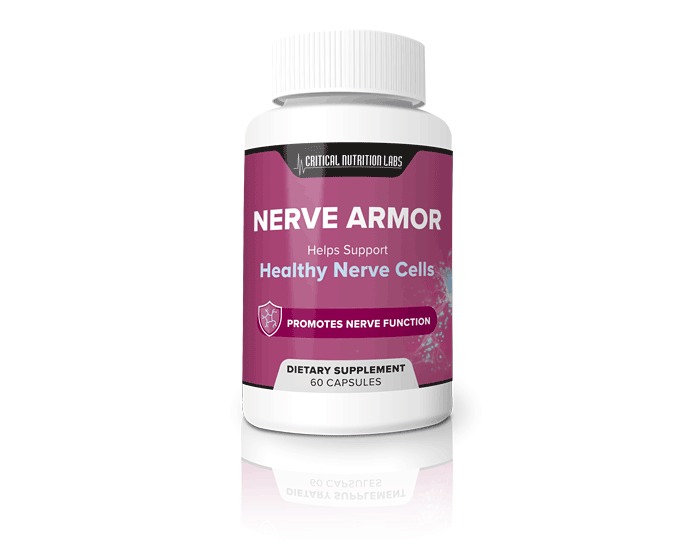
Nerve Armor is a capsule supplement from Critical Bench (sold under Critical Nutrition Labs) built around Palmitoylethanolamide (PEA), a naturally occurring compound studied for nerve pain and inflammation. The sales page frames the product around a dramatized “termite cell” story about aging immune cells (microglia) chewing through nerve fibers, a simplified, non-clinical way of describing a real biological process, but not a term you’ll find in a medical textbook. Below we separate what’s independently verifiable from what’s marketing.
What Is Nerve Armor?
Nerve Armor is a vegetarian-capsule supplement sold exclusively through its official site and fulfilled via ClickBank. It’s positioned by its creator, Chris Wilson (a certified movement/brain-health trainer associated with the Critical Bench fitness brand), as a natural way to “soothe, protect, and regrow” nerves affected by burning, tingling, numbness, or stabbing pain in the hands, legs, and feet. Each bottle contains 60 veggie capsules: a 30-day supply at the standard 2-capsules-per-day serving, or a 15-day supply if you follow the vendor’s recommended “double dose” of 2 capsules in the morning and 2 in the evening.
The formula centers on Palmitoylethanolamide (PEA), an endogenous fatty-acid compound that has been studied for its role in modulating nerve inflammation and pain signaling, combined with four supporting ingredients: gotu kola, corydalis, benfotiamine, and alpha lipoic acid (ALA).
How Does It Work?
According to the sales page, aging causes immune cells in the nervous system called microglia to become overactive and damage the protective myelin sheath around nerve fibers. The vendor’s marketing nicknames these overactive microglia “termite cells.” Microglia and myelin-sheath breakdown are real, studied topics in neuroscience, but “termite cells” is a marketing label invented for this campaign, not an accepted scientific or medical term, and the dramatic framing (a 5-second “egg yolk trick,” a fictionalized client story, thousands of unverifiable customer testimonials) is a hallmark of direct-response supplement marketing rather than clinical communication.
The vendor states that PEA “switches off” overactive microglia and supports myelin repair by boosting Schwann cell activity, citing several published studies on PEA’s anti-inflammatory and neuroprotective properties. These are real, publicly indexed studies on PEA in general. We could not verify that they were conducted on the Nerve Armor formula itself, and none of the cited research proves that any oral supplement reverses existing nerve damage or cures chronic nerve pain in humans. Treat every mechanism claim on the sales page as the vendor’s interpretation of early-stage or preclinical research, not as an established medical fact.
Ingredients Breakdown
| Ingredient | Vendor-Stated Dose | What It’s Said to Do |
|---|---|---|
| Palmitoylethanolamide (PEA) | 450 mg per 2-capsule serving | A naturally occurring lipid compound studied for modulating nerve-related inflammation and pain signaling; the best-researched ingredient in this formula |
| Gotu Kola | Not disclosed on the sales page | Traditional herb used for tissue healing; contains triterpenoid compounds the vendor says support nerve fiber and myelin repair |
| Corydalis | Not disclosed on the sales page | Contains DHCB, a compound studied as a natural pain-signal modulator; used traditionally as a non-opioid pain remedy |
| Benfotiamine | Not disclosed on the sales page | A fat-soluble form of vitamin B1 with better absorption than standard thiamine; studied for supporting nerve cell energy production and antioxidant activity |
| Alpha Lipoic Acid (granular form) | Not disclosed on the sales page | A widely studied antioxidant researched for protecting nerves from oxidative stress |
The vendor discloses an exact milligram dose for PEA only. Gotu kola, corydalis, benfotiamine, and ALA amounts are not published anywhere on the sales page we reviewed. You’d need to see the physical Supplement Facts panel (shown only after ordering) to know the actual doses of four of the five active ingredients. That’s a meaningful transparency gap compared with supplements that publish a full facts panel upfront.
Pros and Cons
Pros
- Built around PEA, a compound with a genuine body of published research on nerve-related inflammation and pain, the most defensible ingredient in the formula
- Includes several other ingredients (benfotiamine, ALA, gotu kola, corydalis) each individually studied in the broader nerve-health research literature
- 60-day money-back guarantee, per the vendor, which is a reasonable window to judge whether it’s helping
- Sold through ClickBank, meaning a standardized checkout and refund process rather than an unregulated seller
- Manufactured in an FDA-registered, GMP-certified U.S. facility, per the vendor, in vegetarian, non-GMO capsules
Cons
- Heavy fear-based marketing: the sales page uses an invented “termite cell” label, a dramatized client story, and aggressive urgency/scarcity language (“your order is set aside,” limited stock) that are typical of direct-response funnels, not clinical communication
- Undisclosed doses for 4 of the 5 active ingredients (gotu kola, corydalis, benfotiamine, ALA). Only PEA’s 450 mg dose is published on the sales page
- Cited statistics (such as a “460% reduction” or “82% improvement”) are attributed to outside studies on individual ingredients, not to clinical trials of the Nerve Armor formula itself
- To hit the vendor’s own recommended “double dose,” a single bottle lasts only 15 days instead of the advertised 30, effectively doubling the real cost per month if you follow their advice
- No independent, third-party lab testing (e.g., NSF, USP, ConsumerLab) is referenced anywhere on the sales page
Pricing & Where to Buy
| Plan | Price | Notes |
|---|---|---|
| 1 bottle (30-day supply) | $59 + $7.99 shipping | Listed “regular price” $125; single-dose serving only |
| 3 bottles (90-day supply) | $49/bottle ($147 total) | Free shipping; vendor’s “Most Popular” option |
| 6 bottles (180-day supply) | $39/bottle ($234 total) | Free shipping; vendor’s “Best Value” option: needed to sustain the recommended double-dose for 90 days |
Nerve Armor is sold only through its official site and fulfilled by ClickBank, which handles the checkout and a standardized 60-day refund process. It is not available on Amazon or in retail stores. Prices, discounts, and shipping fees shown above reflect what we saw at the time of this review. Always confirm the current total on the official checkout page before entering payment details.
Is Nerve Armor Legit or a Scam?
Nerve Armor is not an outright scam in the sense of being a fake or empty product. It’s a real supplement, sold through ClickBank’s standardized retail and refund system, built around an ingredient (PEA) with genuine independent research behind it. But “legit product” and “legit marketing” are two different questions:
- The “termite cell” framing and the fictionalized “Shirley” story are persuasive copywriting techniques, not clinical evidence that this specific formula reverses nerve damage in humans
- Undisclosed doses on 4 of 5 ingredients make it impossible to judge whether those ingredients are present at research-backed levels
- The referenced studies are almost all on individual ingredients in isolation (often in animal or lab models), not on the finished Nerve Armor product. This is common in the supplement industry, but it means the specific “64% faster nerve regrowth” or “82.7% improvement” style statistics should be read as background research context, not as guaranteed results from this bottle
Our takeaway: reasonable core ingredient, questionable marketing, incomplete disclosure. Buyers should weigh the 60-day guarantee against the aggressive urgency tactics and go in with realistic expectations.
Frequently Asked Questions
Does Nerve Armor cure neuropathy or reverse nerve damage?
No. The vendor’s marketing implies dramatic, fast reversal of nerve damage, but there is no independent clinical trial proving that Nerve Armor cures neuropathy, reverses existing nerve damage, or replaces any prescribed treatment for a diagnosed nerve condition. Persistent nerve symptoms should be evaluated by a doctor.
What’s actually in Nerve Armor?
Five ingredients: PEA (450 mg per serving, the only disclosed dose), gotu kola, corydalis, benfotiamine, and alpha lipoic acid, in vegetarian capsules manufactured in the USA, per the vendor.
How do I take it?
The vendor’s standard instruction is 2 capsules each morning. The vendor also recommends a “double dose” (2 capsules AM and 2 capsules PM) for faster results, which uses a bottle in 15 days instead of 30.
Is there a guarantee?
Yes, the vendor advertises a 60-day money-back guarantee. Confirm the exact terms and process on the official checkout and guarantee pages before purchasing.
Can I buy Nerve Armor on Amazon or in stores?
No. Per the vendor, it’s sold exclusively through the official site and fulfilled via ClickBank. There is no authorized retail or Amazon listing.
Final Verdict
Nerve Armor’s headline ingredient, PEA, has real published research behind it for nerve-related inflammation and pain, and the supporting cast (gotu kola, corydalis, benfotiamine, ALA) are all ingredients you’ll find studied elsewhere in nerve-health literature. That’s a genuinely defensible starting point. What drags the score down is the packaging around it: an invented “termite cell” label dressed up as a scientific discovery, a dramatized customer story, aggressive scarcity language, and (most importantly) no published dose for four of the five active ingredients. If you’re going to try it, go in with realistic expectations, use the 60-day guarantee as your safety net, and see a doctor first if your nerve pain, numbness, or tingling is new, severe, or getting worse.
Ready to see current pricing and packages? Check the official Nerve Armor site →
Before you buy: this product’s official sales page may present its claims more confidently than the independent research on its ingredients currently supports. Read the breakdown above, weigh it against the vendor’s own marketing, and decide for yourself before you check out.
See also our direct Nervala vs Nerve Armor comparison.